
Two things do most of the work. First, confirm the person planning your treatment completed an accredited orthodontic residency after dental school. Second, judge the consultation by whether you leave with an actual diagnosis — what’s going on with your bite, why it’s happening, what the options are, and what each one costs — or whether you leave with a price and a start date. A good consultation explains your case back to you in terms you can repeat to your spouse that night. If you get that, you’re in good hands. Everything below is how to check those two things, plus the practical questions worth asking before you commit to a year or two of appointments.
What’s the difference between an orthodontist and a dentist who does braces?
Training length and case volume, mostly.
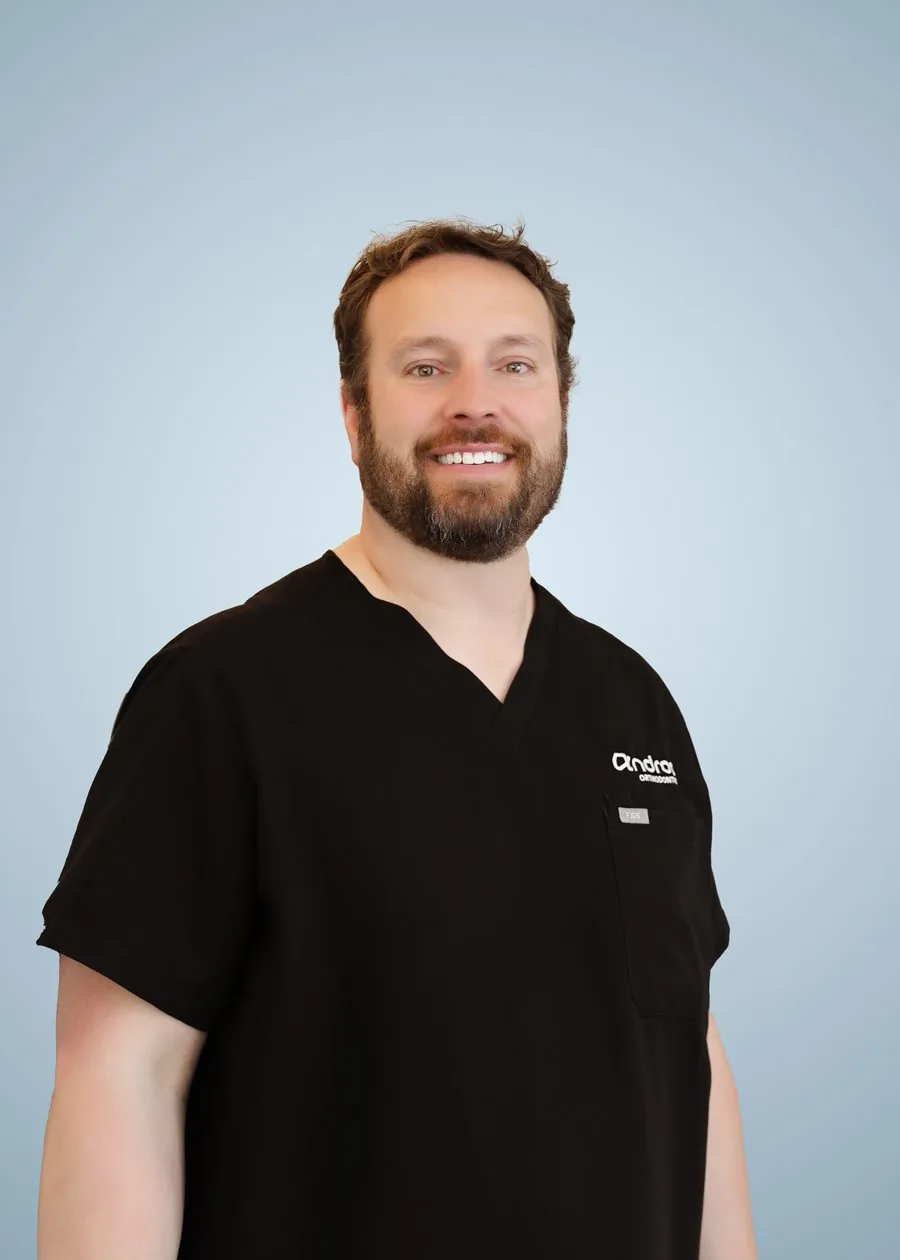
Every orthodontist is a dentist first. After dental school, an orthodontist completes an additional two to three years of full-time residency dedicated to nothing but tooth movement, jaw growth, and facial development. My own path was a DDS from Columbia University in 2011, then orthodontic residency at Jacksonville University through 2014.
General dentists can legally provide orthodontic treatment, and plenty of them do good work at it — particularly on straightforward cases, and particularly when they’ve invested real continuing education into it. This isn’t a question of who’s a good clinician. It’s a question of what you’re specifically shopping for. If your case is complicated, if there’s a skeletal component, if there’s an airway question, or if you simply want the person who does this all day every day, a specialist is the more direct path.
You can verify residency training in about thirty seconds. Ask, or look it up on the practice’s site. It’s not a rude question and nobody minds being asked.
What does board certified actually mean?
It means the orthodontist voluntarily submitted finished cases to a panel of peers for examination, and passed.
Residency gets you licensed. Board certification through the American Board of Orthodontics is optional, and it’s the one credential that involves other orthodontists looking at your actual finished results and grading them. Not every orthodontist pursues it. I’m a Diplomate of the ABO, and I’ll tell you honestly what it is and isn’t: it isn’t a guarantee that you’ll like someone, and it isn’t a claim that non-certified orthodontists produce worse outcomes. It’s simply a verifiable signal that this person’s work has been reviewed by people qualified to review it, and that they chose to put it up for review.
Use it as one input. Don’t use it as the only one.
What should a first consultation actually include?
This is the part that separates practices more than credentials do, and it’s the part you can evaluate yourself without knowing anything about orthodontics.
A complete consultation should include a clinical exam, diagnostic imaging when it’s clinically indicated, a conversation about what you’re actually hoping to change, and a treatment plan that lays out the appliance, the timeline, the number of visits, and the cost — before you’re asked to decide anything. At our office that visit runs about an hour, includes CBCT 3D imaging when indicated, includes an airway screening, and is complimentary with no obligation to start.
Here’s the test I’d apply if I were the patient: can you explain your own diagnosis to someone else afterward? Not “I need braces.” More like “my lower jaw sits back, which is why my front teeth stick out, and the plan uses growth to bring it forward.” If you can say something like that, you were given a diagnosis. If all you came away with is a monthly payment, you were given a quote.
Also worth noticing: does the plan include what happens after the appliance comes off? Retention isn’t a footnote. Teeth drift back toward their old positions, fastest in the first six months and slowly for years after, and any honest treatment plan accounts for that from day one. If retainers didn’t come up at the consultation, ask about them.
Do I need a referral from my dentist?
No. Orthodontists are specialists you can see directly, and no referral is required.
Many of our patients arrive on a referral from their general dentist or pediatrician, and many just book themselves. Both paths are completely normal and both are welcome. If your dentist did recommend someone specific, that’s a meaningful signal — dentists see the finished results of local orthodontists constantly and have strong opinions — but it isn’t binding, and you’re free to get a second opinion.
Second opinions, incidentally, are welcome anywhere reputable. If a practice makes you feel awkward for wanting one, that itself is information.
How much does location really matter?
More than people expect, and for a boring reason: you’re going to drive there a lot.
Comprehensive treatment typically means appointments every six to ten weeks over a year or two, scheduled around school and work. A twenty-minute drive versus a fifty-minute drive is the difference between a manageable habit and the thing that makes you reschedule twice and stretch your timeline. Missed and delayed appointments are one of the most common reasons treatment takes longer than planned.
That said, don’t let a fifteen-minute difference override a meaningfully better fit. Across the Tri-Cities — Pasco, Kennewick, Richland, West Richland, Burbank — nothing is far enough apart to be the deciding factor. Weigh proximity when the clinical options look equivalent, not as a tiebreaker over the plan itself.
Two practical logistics questions worth asking: how does the office handle something breaking between appointments, and can you reach a human quickly when it does? Ours run through texting, which reaches our team faster than a phone call. A broken bracket sitting for two weeks is a real cost — that tooth stops moving on schedule.
How should I read online reviews?
Read the middle, not the extremes.
Five-star reviews tend to be about the front desk and the vibe. One-star reviews tend to be about billing or a scheduling conflict. Neither tells you much about clinical quality, because patients — reasonably — aren’t in a position to evaluate whether their finished occlusion is textbook.
What’s actually useful in reviews is the pattern of the boring stuff: do people mention running on time, or waiting an hour? Do they mention the same staff members by name across several years, or does the team seem to turn over? Does the practice respond to criticism like adults? Consistency over years is worth more than the number itself.
And look at treatment photos if the practice publishes them. Not the highlight reel of perfect teenage smiles — look for cases that resemble yours.
What questions should I ask at the consultation?
A short list that gets you most of what you need:
- What exactly is my diagnosis, and what’s causing it?
- What are my options, including doing nothing? There should be more than one, and “wait and monitor” is sometimes the right answer.
- Who will I actually see at appointments — you, or an assistant? Both answers are fine. You just want to know.
- What’s the total cost, what does insurance cover, and what happens if treatment runs long?
- What’s the retention plan, and what does replacing a retainer cost in five years?
- What happens if I move, or if my child goes to college mid-treatment?
If you’re weighing whether you need treatment at all, our post on whether orthodontic treatment is necessary covers how to think about that honestly. And if this is for a child, the American Association of Orthodontists recommends a first screening by age 7 — worth knowing that most kids screened that early need nothing yet, and that’s a completely successful visit.
One thing that isn’t a shortcut
Mail-order aligners deserve a plain answer, because the price is genuinely tempting.
An orthodontic diagnosis requires seeing the roots and the bone, not just the crowns of the teeth. Impressions or photos taken at home don’t show whether a tooth has adequate bone around it, whether roots are positioned to move safely, or whether the underlying problem is skeletal rather than dental. Tooth movement without that information is a real risk to teeth that are currently healthy. This isn’t about any particular company. It’s that the diagnosis step can’t be done remotely, and the diagnosis is the part that protects you.
Clear aligners themselves are excellent — supervised, they can treat virtually any case braces can treat. The variable is wear time, 20 to 22 hours a day, not case complexity.
The short version
Verify the training. Judge the consultation by whether you got a diagnosis or a quote. Ask about retention before you start. Then pick the office you’d actually be willing to drive to fifteen times.
If you’d like a second opinion or a first one, a free consultation at our Pasco office covers the diagnosis, the options, the timeline, and the cost with no obligation to start. Our FAQ page answers the common logistics questions, and you can read more about my training and approach before you come in. Text or call (509) 792-1008. Se habla español.