
How most orthodontics still works
Standard orthodontic bracket placement has barely changed in fifty years. The orthodontist looks at the patient's tooth, picks up a bracket with tweezers, eyeballs the position on the tooth, applies the bonding adhesive, places the bracket on the enamel, and cures it in place with a brief blast of curing light. Repeat for every tooth, one at a time. The orthodontist is doing this from memory of the case, with the patient lying back in the chair, with limited visibility, against the clock.
The technique works. Most orthodontists are skilled at it. But small inaccuracies are unavoidable — a bracket placed half a millimeter too high, or angled a few degrees off-axis, or shifted slightly mesial. Those small errors compound. By the time the wires start pulling teeth, the mechanics aren't quite what the orthodontist planned. The treatment plan adjusts. Bends are added to the wires. Brackets are re-bonded. A treatment that was supposed to take 18 months takes 24. The final result is usually fine — but the path to it isn't the one the orthodontist drew at the consultation.
For most of orthodontic history, this was the only option. Tooth movement is biological — it isn't going to be perfectly predictable no matter what you do. So the chairside approach was good enough.
What changed
Three technologies converged: CBCT 3D imaging, intraoral scanning, and 3D printing. Together, they make it possible to move the precision step away from the patient's chair and into the planning phase, where mistakes can be caught and corrected before they affect treatment.
The workflow at Andros Orthodontics looks like this:
Step 1 — CBCT 3D imaging and intraoral scanning
The case starts with a cone-beam CT scan, which captures the exact three-dimensional position of every tooth root, the surrounding alveolar bone, the upper airway, the maxillary sinuses, and the palate. An intraoral scan then captures the precise crown geometry — the visible shape of each tooth, the bite, the existing arch form. Together, these two scans give a complete digital model of the patient's mouth.
This step alone is a significant upgrade over traditional orthodontics. Most orthodontists rely on 2D panoramic and cephalometric X-rays, which compress three-dimensional anatomy onto a flat image. A 2D X-ray can tell you a root is there. It cannot tell you where it sits relative to its neighbor, or how close it is to the cortical bone, or whether you're about to drive it into a sinus floor.
Step 2 — Virtual case planning
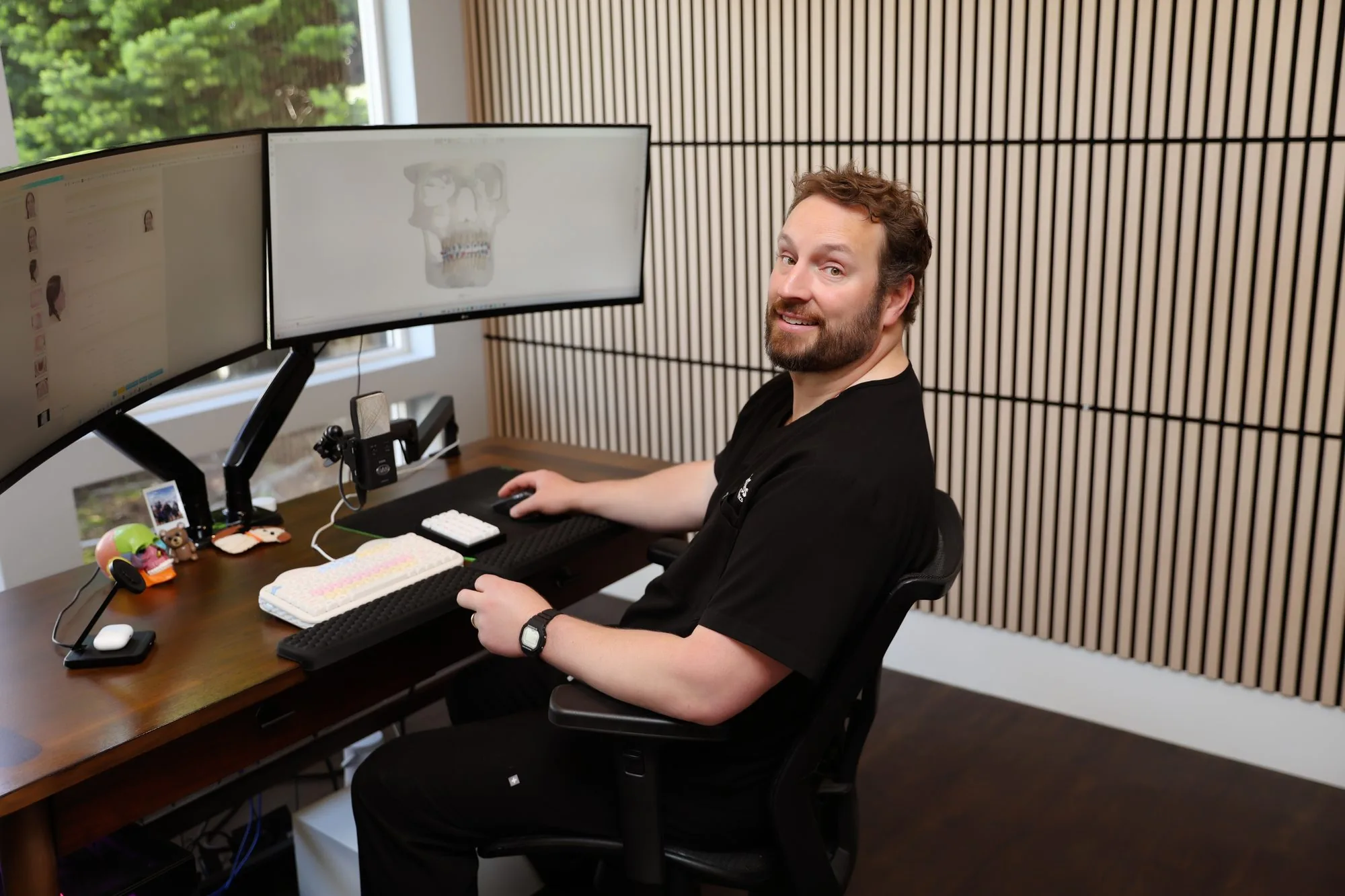
With the full 3D model in software, Dr. Andros plans the entire case before the patient returns for bonding. Every tooth movement is mapped. The final occlusion is set. The arch form is designed. Roots are checked against neighboring roots, against cortical bone, against any restorative work. The plan accounts for facial aesthetics, airway considerations, and long-term stability — not just whether the teeth fit together at the end.
If the plan reveals a problem — a root that would collide with a neighboring root if the planned movement happens, for example, or an extraction that would leave inadequate bone for an implant later — that problem is solved on the computer, not discovered six months into treatment.
Step 3 — Custom 3D-printed indirect bonding tray
Once the plan is locked in, the software calculates the exact bracket position required on each tooth to deliver the planned movement. A 3D-printed bonding tray is fabricated that holds every bracket in its planned position. The tray is custom to this patient and this treatment plan — it doesn't exist anywhere else.
At the bonding appointment, all brackets are seated simultaneously. The tray is positioned over the teeth, every bracket is cured at the same time with a sweep of the curing light, and the tray is removed. Every bracket ends up exactly where the plan called for it to be — not where it was placed by eye in a busy clinical moment.
Step 4 — Engineered wire sequence with Damon Ultima brackets
Because the brackets are exactly where they should be, the wire sequence does what it's supposed to. There are no mid-course detours required to compensate for a bracket that ended up slightly off-target. The treatment progresses on the timeline that was modeled in software — typically faster than the same case would take with traditional methods, and with significantly fewer "we need to adjust this" moments mid-treatment.
The brackets themselves matter here. Andros Orthodontics uses Damon Ultima brackets for every patient — the newest and most customizable generation of the Damon system, widely regarded as the premium bracket system in orthodontics. Most practices that offer Damon Ultima offer it as a paid upgrade. We don't. It's our standard system for every case.
Why Damon Ultima — and why every patient gets it
The bracket is the tool that translates the wire's force into tooth movement. Different bracket systems do this differently. Traditional twin brackets hold the wire in place with a small rubber band (an elastic ligature) at every appointment. The friction between the wire, the bracket, and the rubber band slows tooth movement and requires more force to overcome — which means more discomfort and more sensitivity for the patient between visits.
Damon brackets are self-ligating. Instead of a rubber band, each bracket has a built-in sliding door that holds the wire while letting it slide through the bracket with minimal friction. Damon Ultima, the most recent generation of the Damon system, takes this further in two specific ways that matter:
- Variable torque across the arch. Ultima brackets are manufactured with different prescriptions for different teeth — the front teeth get one angulation, the canines another, the molars another. The bracket itself delivers a different planned position to each tooth without the orthodontist having to bend the wire to compensate.
- Full slot engagement early in treatment. Ultima is designed around wires that completely fill the bracket slot from early in the wire sequence, rather than gradually building toward full engagement over months. The bracket is delivering its full planned prescription from the start, not slowly working into it as treatment progresses.
Translated to patient experience, the result is meaningfully different from earlier bracket systems:
- More comfortable. Lower friction means less force is needed to move the teeth, and less force generally means less soreness between appointments.
- More predictable mechanics. The teeth move along the wire the way the wire is engineered to move them — without rubber-band friction adding variability.
- Fewer emergency visits. No rubber ligatures to come loose or break.
- Easier hygiene. Without rubber ligatures collecting plaque, brushing and flossing around brackets is genuinely easier.
- Often shorter treatment times. The combination of full slot engagement, reduced friction, and the indirect bonding precision compounds into measurable time savings on many cases.
- More cases treatable without extractions. The lighter forces and biological response Damon delivers often allow arch development that traditional systems would require extractions or expansion appliances to achieve.
The trade-off is cost. Damon Ultima brackets are significantly more expensive at the supply level than standard twin brackets, which is why most orthodontic practices that offer Damon Ultima offer it as an upgrade tier — and many practices don't offer it at all. Andros Orthodontics uses Damon Ultima as the standard system for every patient. There's no upgrade tier. If you're being treated here, you're getting the premium system.
What this means for you as a patient
Patients don't experience the workflow directly — they experience the results of it. Practically:
- The treatment timeline you're told at the consultation is the timeline you actually get. Because the mechanics are engineered in advance, treatment runs to the plan with rare exceptions.
- Fewer appointments. Mid-course corrections, bracket re-bonds, and unplanned wire adjustments are uncommon — which means fewer visits and less time in the chair.
- Shorter total treatment time. Most cases finish on or ahead of the planned schedule rather than running over.
- Lower risk of root resorption or root collision. CBCT-based planning identifies these risks before they become problems. For complex adult cases, this is particularly significant.
- Better final result. Precision in bracket position translates directly to precision in tooth position. The teeth end up where the plan said they would.
- One bonding visit, not multiple. All brackets go on at one appointment, simultaneously, rather than over a longer visit of one-at-a-time placement.
Honest framing — what this doesn't change
Digital orthodontics doesn't eliminate biology. Tooth movement still depends on the patient's bone, age, and individual response. Compliance with elastics, retainers, and oral hygiene still matters. The orthodontist's judgment in designing the treatment plan still matters far more than the technology executing it.
What digital orthodontics does is remove preventable errors from the technical execution side of orthodontics — so that the biology of the case is the only variable that matters. That's a meaningful improvement for almost every patient, but it doesn't promise a result that biology won't allow.
Who's a candidate
Every patient at Andros Orthodontics is treated using the digital workflow. Whether the case is straightforward braces for a teenager, complex adult orthodontics with restorative coordination, MARPE/MASPE skeletal expansion, or airway-focused intervention, the workflow starts with CBCT-based digital planning and proceeds to 3D-printed indirect bonding. There is no "digital orthodontics package" patients have to upgrade to — it's how the practice works.
The financial plan for any case is the same as it would be at a comparable orthodontic practice using traditional methods. The improved precision and predictability is included.